SuppliesGuide
Scratching Posts for Large Cats: Height, Weight and Sisal
How tall a scratching post should be for a large cat, why the base matters more for heavy cats, sisal versus carpet, and where to put posts, from vet guidance.
We earn from qualifying purchases through links on this page. How we make money.
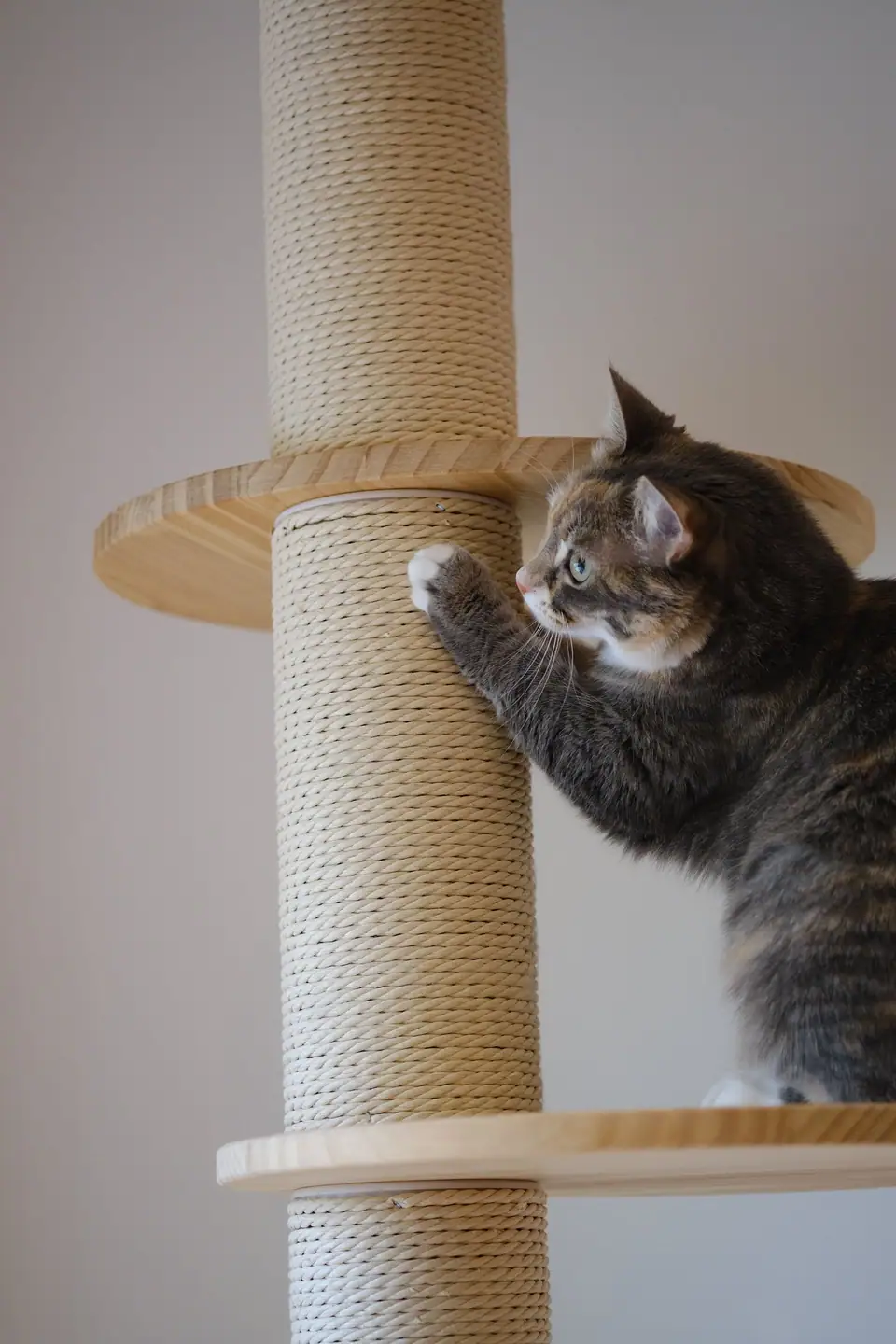
A scratching post for a large cat should be taller than the cat at full stretch, often 3 feet or more for a big breed, with a heavy base that does not wobble. The American Association of Feline Practitioners (AAFP) says scratchers must allow full stretching and be stable enough not to move or fall over. Sisal suits most cats.
Height and stability are where standard posts fail big cats. A short post makes a Maine Coon hunch instead of stretching, and a light base tips when a 20-pound cat pulls on it, which can put a cat off the post for good. International Cat Care notes that lightweight scratchers that move during use may simply not be used.
How tall should the post be?
Measure your cat standing on its hind legs, reaching up. The guidance agrees on the principle:
- The AAFP’s Claw Friendly toolkit says vertical options “must be sturdy and extend above the cat’s stretched out vertical height.”
- International Cat Care says a post should be “as tall as your cat is when standing on their hind legs in a full stretched scratching position.”
- The AAFP’s declawing statement asks for scratchers “tall or long enough to allow full stretching.”
The same toolkit cites a survey of cat owners (Wilson and colleagues, Journal of Feline Medicine and Surgery, 2016) in which the ideal post was “a simple upright structure with 2-3 levels, at least 3 feet tall.” For a large breed, treat 3 feet as a starting point, not a maximum.
Why the base matters more for heavy cats
A tall post on a small base is a lever. Cats Protection asks for “a heavy, stable base so it doesn’t wobble or topple during use.” When comparing listings, look at the base dimensions and the post’s weight, not only its height. A post fixed to a cat tree’s wide base, or screwed to a wall where the maker allows it, is steadier still. Our guide to cat trees for large cats covers base and post sizes in more detail.
Tall, heavy-base scratching posts
Live listings, shown by eBay
Opens eBay in a new tab. Check condition, seller feedback and returns.
Sisal, carpet or cardboard?
The AAFP lists wood, sisal rope, carpet, cardboard and rough fabric as scratching materials. In the survey cited in its toolkit, most cats aged nine and under preferred sisal rope, while cats aged ten and over slightly preferred carpet, then sisal. A few practical points:
| Material | Notes |
|---|---|
| Sisal rope | The most common choice for vertical posts; can be rewrapped |
| Sisal fabric | Flat weave; a smooth surface some cats prefer |
| Carpet | Liked by some older cats in the AAFP-cited survey |
| Corrugated cardboard | Good for horizontal scratchers; wears out and is replaced |
Offer both vertical and horizontal surfaces. The AAFP notes scratchers “may be vertical or horizontal,” so offering both gives a big cat a choice.
Where to put scratching posts
- Near where the cat sleeps. The AAFP and International Cat Care both suggest this.
- Next to the furniture being scratched. Put the post in front of the target, then move it gradually.
- One per cat, plus one, in different rooms, for multi-cat homes, as International Cat Care suggests.
Encourage use with catnip, treats, toys and praise. The AAFP says cats should “never” be punished for scratching.
Scratching, claws and declawing
Scratching keeps claws in shape, but posts do not replace nail care entirely. International Cat Care notes that older or less mobile cats scratch less, and their claws can overgrow; see the nail trimming section of grooming a Maine Coon.
The AAFP “strongly opposes declawing (onychectomy) as an elective procedure.” Its position statement recommends suitable scratchers, training and nail trims instead. If your cat scratches furniture, the answer is a better post in a better spot.
For the rest of the sized-up basics, see the supplies hub and toys for large cats.
Frequently asked questions
How tall should a scratching post be for a large cat?
Tall enough for the cat to stretch to full length while scratching. The AAFP says vertical posts should extend above the cat's stretched-out height, and International Cat Care says as tall as the cat standing on its hind legs at full stretch. For a big breed that often means 3 feet or more.
Is sisal or carpet better for a scratching post?
Many cats prefer sisal rope. A survey cited in the AAFP's Claw Friendly toolkit found most cats aged nine and under preferred sisal, while older cats slightly preferred carpet. Offering more than one texture is the safe choice.
How many scratching posts does a cat need?
International Cat Care suggests one per cat plus one extra in a home with several cats, placed in different spots. The AAFP and International Cat Care both suggest one near where the cat sleeps.
Should I declaw a large cat that scratches furniture?
No. The AAFP strongly opposes declawing as an elective procedure and recommends suitable scratchers, training with rewards and nail trims instead.
Sources
- AAFP Position Statement: Declawing (2017)American Association of Feline Practitioners
- AAFP Claw Friendly Educational Toolkit: Scratching ResourcesAmerican Association of Feline Practitioners
- Scratching on furniture and carpetsInternational Cat Care
- ScratchingCats Protection
- Trimming your cat's clawsInternational Cat Care
Filed under SuppliesStart with Supplies for Large Cats: What to Size Up and What to Skip
Keep reading
Start here
Supplies for Large Cats: What to Size Up and What to Skip
Which cat supplies need sizing up for a large cat, from litter boxes and trees to carriers and harnesses, how to measure your cat, and what can stay standard.
Supplies
Question
Carriers for Large Cats: Size, Hard vs Soft, and Air Travel
What size carrier a large cat needs, hard versus soft carriers for vet visits, carrying a heavy cat, and the airline in-cabin limits that rule out big cats.
Supplies
Comparison
Cat Trees for Large Cats: Base, Posts and Perches That Hold
How to choose a cat tree for a large, heavy cat: base footprint, post thickness, perch size, maker weight limits, wall straps and furniture-grade options.
Supplies