CareQuestion
Heart and Hip Problems in Large Cat Breeds: What Owners Should Know
Which large breeds are prone to heart disease (HCM), what gene tests can and cannot tell you, hip dysplasia and SMA in Maine Coons, and what to ask your vet.
We earn from qualifying purchases through links on this page. How we make money.
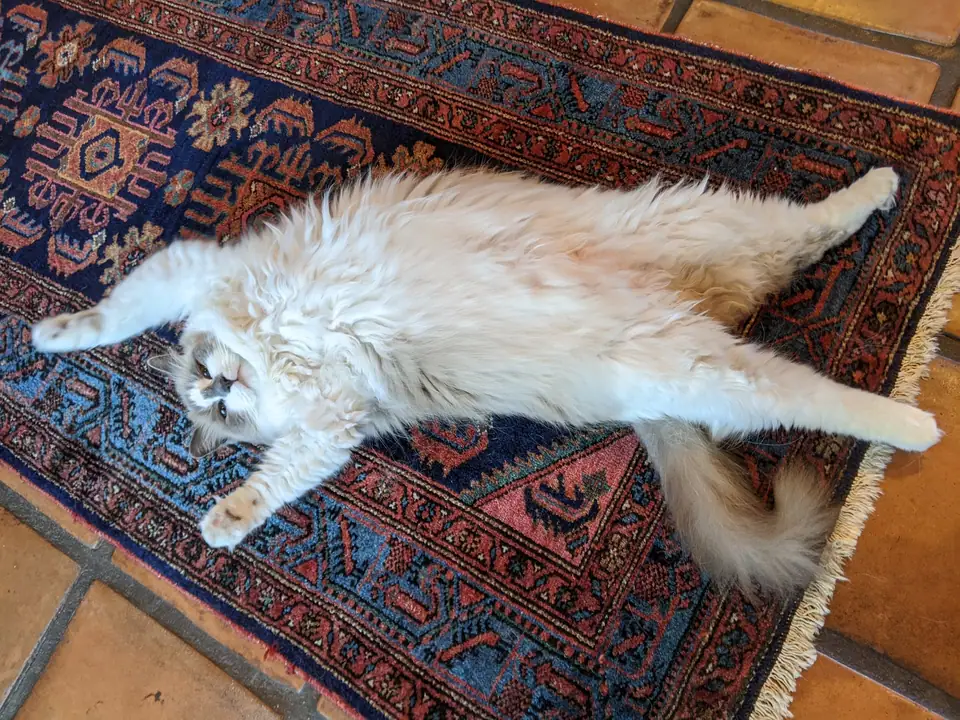
Several large breeds are more prone to hypertrophic cardiomyopathy (HCM), the thickening of the heart muscle: Cornell lists the Maine Coon, Ragdoll, Norwegian Forest Cat, Siberian and British Shorthair among them. Gene tests flag known mutations, but a positive test is not a diagnosis. Hip dysplasia is also common in screened Maine Coons. Your vet decides on screening.
This page explains what the conditions are, what the tests can and cannot tell you, and what to ask at your next visit. It does not diagnose or treat anything. If your cat is breathing fast, collapses or suddenly cannot use its back legs, call a vet straight away.
What is HCM, and which breeds are at risk?
HCM is a disease in which the wall of the heart’s main pumping chamber thickens. Langford Vets at the University of Bristol calls it “the most common form of heart disease found in domestic cats.” Cornell Feline Health Center lists breeds in which it is more prevalent: Maine Coon, Ragdoll, British Shorthair, American Shorthair, Sphynx, Bengal, Chartreux, Norwegian Forest, Siberian and Persian.
The difficulty is that “many cats with HCM do not appear to be ill,” in Cornell’s words. Cornell names echocardiography, an ultrasound of the heart, as “the gold standard” for diagnosis: non-invasive and very accurate.
What a gene test can and cannot tell you
Two breed mutations have tests. In Maine Coons the test looks for the MYBPC3 A31P variant; in Ragdolls, the R820W variant. How common the Ragdoll variant is depends on the population studied: a 2014 study of Ragdolls tested in the British Isles found it in 27 percent, while Langford Vets gives a figure of around 13 percent.
| Test result | What it means | What it does not mean |
|---|---|---|
| Positive, one copy | Higher risk than a cat without the variant | That the cat has or will get HCM |
| Positive, two copies | Higher risk, more likely to be affected earlier (Langford Vets) | A certain outcome |
| Negative | The cat lacks this one variant | That the cat cannot get HCM |
Cornell says genetic results should be interpreted with a veterinary professional, because “not all cats that have these mutations will develop the condition.” A 2013 study in the Journal of Veterinary Internal Medicine estimated the penetrance of A31P in Maine Coons at 0.08 for one copy and 0.58 for two, rising with age. Langford Vets says Maine Coons with two copies are “more likely to develop moderate to severe disease earlier in life,” and recommends considering heart ultrasound for cats with a positive result.
Questions for your vet
- Does my cat’s breed or history make heart screening worthwhile, and how often?
- Is there a murmur or abnormal rhythm at today’s exam?
- Should a gene test result change how often we screen?
- Are my cat’s hips and joints moving normally for its age?
- What body condition score should we aim for?
Hip dysplasia in Maine Coons
Hip dysplasia is a loose hip joint, caused by a shallow socket or a misshapen head of the thigh bone. Two screening studies suggest it is common in Maine Coons:
- US records. A study of Orthopedic Foundation for Animals records, published in the Journal of Feline Medicine and Surgery, found hip dysplasia in 24.9 percent of screened cats, 27.3 percent of males and 23.3 percent of females. The youngest affected cat was 4 months old. The authors caution against applying the figure to other groups.
- Swedish screening. A 2019 study of 5,038 pedigree Maine Coons found some radiographic signs in 37.4 percent, with no sex difference. It found a genetic link between hip dysplasia and body mass, and that selecting for healthier hips over eight generations improved scores.
Both studies counted cats sent for screening, so they are not your cat’s odds. They are a reason to watch a big cat’s movement.
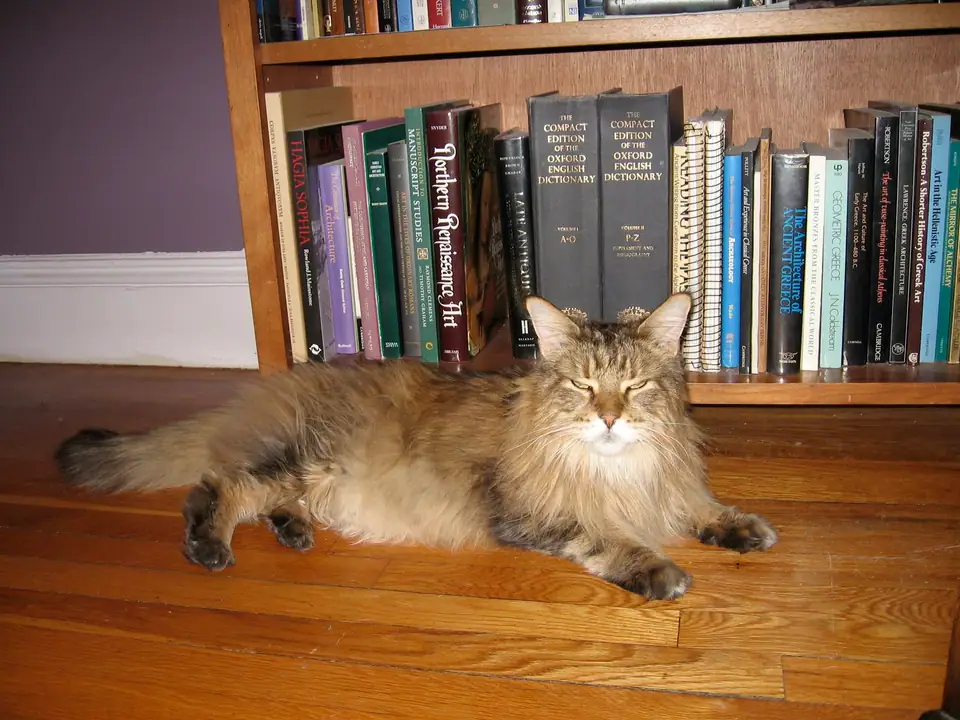
Signs to mention to your vet, from International Cat Care’s arthritis guidance: reluctance to jump up or down, stiffness after rest, difficulty with the litter tray and less grooming. At home, the same source suggests steps or a ramp to high places and a litter tray with at least one low side. Keeping the cat lean matters too; see body condition in the care section.
Spinal muscular atrophy (SMA)
SMA is an inherited condition of Maine Coons that causes loss of the nerve cells controlling the limb muscles. Langford Vets says signs “become apparent by 3-4 months of age,” with an abnormal gait, and that affected cats are typically too weak to jump correctly by 6 months. It is autosomal recessive, so a cat must inherit two copies to be affected. Langford notes that affected cats “can live relatively normal lives indoors and appear not to be in pain.”
How the gear fits in
A cat with stiff hips or a heart condition still needs to climb, play and use its box. Low-entry litter boxes, wide steady perches and ramps help. See litter boxes for large cats and cat trees for large cats, and read how big Maine Coons get for size and lifespan.
Frequently asked questions
Do Maine Coons have heart problems?
The Maine Coon is one of the breeds Cornell lists as more prone to hypertrophic cardiomyopathy (HCM), the most common heart disease in cats. Many affected cats look healthy, so ask your vet whether heart screening by echocardiogram makes sense for your cat.
If my Maine Coon tests positive for the HCM gene, will it get heart disease?
Not necessarily. Cornell says not all cats with these mutations develop the condition. In a 2013 study, the Maine Coon A31P variant showed low penetrance with one copy and higher penetrance with two. A positive result is a reason for screening, not a diagnosis.
Does a negative HCM gene test mean my cat is clear?
No. Langford Vets notes that other, as yet unidentified genetic mutations can also cause heart disease. The gene test covers one known variant; an echocardiogram looks at the heart itself.
How common is hip dysplasia in Maine Coons?
Studies of screened cats put it high: 24.9 percent in US Orthopedic Foundation for Animals records and 37.4 percent in a Swedish screening program. Those are cats sent for screening, so treat the figures as a sign the condition is common, not as your cat's odds.
Sources
- Hypertrophic CardiomyopathyCornell Feline Health Center
- Maine Coon Hypertrophic Cardiomyopathy (MC-HCM)Langford Vets, University of Bristol
- Ragdoll Hypertrophic Cardiomyopathy (RD-HCM)Langford Vets, University of Bristol
- Prevalence and demographics of the MYBPC3-mutations in ragdolls and Maine coons in the British Isles (2014)Journal of Small Animal Practice, via Europe PMC
- Myosin-binding protein C DNA variants in domestic cats (A31P, A74T, R820W) and their association with hypertrophic cardiomyopathy (Longeri et al., 2013)Journal of Veterinary Internal Medicine, via PubMed Central
- Demographics of hip dysplasia in the Maine Coon cat (Loder and Todhunter)Journal of Feline Medicine and Surgery, listed by the AAFP
- Demography, heritability and genetic correlation of feline hip dysplasia and response to selection in a health screening programme (Low et al., 2019)Scientific Reports, via PubMed Central
- Spinal Muscular AtrophyLangford Vets, University of Bristol
- Spinal muscular atrophy, LIX1-related in Felis catusOnline Mendelian Inheritance in Animals, University of Sydney
- Arthritis in catsInternational Cat Care
Filed under CareStart with Caring for a Large Cat: Weight, Joints, Heart and Grooming
Keep reading
Start here
Caring for a Large Cat: Weight, Joints, Heart and Grooming
How caring for a large breed cat differs from an average cat: judging weight by body condition, joints, heart screening, feeding and grooming, from vet sources.
Care
Question
Feeding a Maine Coon: How Much, What Kind, and When to Ask a Vet
What a Maine Coon needs from its food: the life stage on the label, calories for an ideal body condition, wide bowls, and the evidence on breed foods.
Care
Guide
Grooming a Maine Coon: Brushing, Mats and Nail Trims
How to groom a Maine Coon or other big long-haired cat: how often to brush, the tools to use, what to do about mats, nail trims and whether to bathe.
Care